

Planiranje proizvodnje
Ko u vašoj fabrici sme da promeni plan proizvodnje?
Plan proizvodnje postoji, a menjaju ga direktor, prodaja i smenovođa. Posledica su preopremanje mašina, izgubljen kapacitet i zakasnele isporuke.

Najveće probleme u planiranju proizvodnje često prave baš ljudi koji su odgovorni da se plan poštuje. U fabrikama u kojima radim plan proizvodnje postoji, ali ga u praksi može da promeni skoro svako. Direktor menja prioritete, prodaja daje naloge direktno proizvodnji, a rukovodilac pogona i smenovođa samostalno odlučuju šta će se raditi i kojim redosledom.
Kako izgleda plan koji svako može da promeni
Plan se ujutru odštampa i okači na tablu. Do deset sati prvi radni nalog je već prekinut, jer je komercijala obećala kupcu raniji rok. Direktor prođe kroz halu i traži da se prvo uradi njegov kupac. Smenovođa vidi da za treći nalog nedostaje materijal i stavi četvrti ispred njega. Svaka od tih odluka ima svoj razlog i svaku je neko doneo u dobroj nameri. Zajedno daju pogon u kome niko ne zna šta će se raditi posle podne.
Šta firma plaća zbog stalnih izmena plana
Svaka promena prioriteta znači preopremanje mašine, podešavanje alata i probne komade pre nego što krene dobra serija. To je vreme u kome mašina stoji, a radnik je plaćen. Zbog toga se gubi kapacitet i kasne isporuke, iako su mašine radile ceo dan. Radnici trpe pritisak, jer posao koji su počeli odjednom više nije važan, a ono što su morali da prekinu posle se traži kao hitno. Planer u takvoj firmi uglavnom prepravlja raspored, a vreme mu odlazi na probleme koje su izmene napravile.
Šta je Tejlor napisao 1903. godine
Frederik Vinslov Tejlor je u knjizi Shop Management napisao da radnjom, pa i celom fabrikom, treba da upravlja planski odeljak, a ne direktor, nadzornik ili poslovođa. Od tada je prošlo 123 godine, a isti problem srećem u mnogim fabrikama.
Kako rešavam ovaj problem
Prvo pitanje koje postavljam je ko je vlasnik plana. Mora da postoji jedno ime, a ne tri. Zatim se napiše pravilo: ko sme da traži izmenu, ko je odobrava i do kog trenutka u smeni je izmena moguća. Hitan nalog dobija svoje mesto u planu preko planera, a ne preko leđa smenovođi.
Plan mora da počiva na realnim vremenima. Kada su standardna vremena i kapacitet linije izmereni, planer zna šta staje u smenu, a šta ne staje, pa direktoru i prodaji može da kaže realan rok isporuke umesto obećanja koje će se kasnije lomiti. Za to koristim izmerena standardna vremena i analizu uskog grla.
Na početku smene proveravam da li je proizvodnja krenula po planu. Ako nije, uzrok se zapiše istog dana: nedostaje materijal, alat nije spreman, mašina je u kvaru. Tako se vidi koja se odstupanja ponavljaju i rešavaju se na korenu, a ne svaki put iznova. Za izmene tokom dana unapred se dogovara plan B, zajedno sa logistikom i sa pogonom. Logistika poznaje prioritete snabdevanja, a pogon zna šta mašine i ljudi mogu da isporuče.
Probajte ovu nedelju
Zapišite ko je u fabrici u poslednjih sedam dana promenio plan proizvodnje, koliko puta i zbog čega. Za svaku izmenu upišite koliko je trajalo preopremanje i koji je nalog zbog toga zakasnio. Spisak je obično duži nego što očekujete.
Ko u vašoj fabrici stvarno planira proizvodnju i ko ima ovlašćenje da promeni dogovoreni plan?
Kada se plan stalno menja, vredi izmeriti gde se u pogonu zaista gubi kapacitet. Analiza uskog grla pokazuje gde proizvodnja staje i zašto rokovi isporuke ne drže.
Production planning
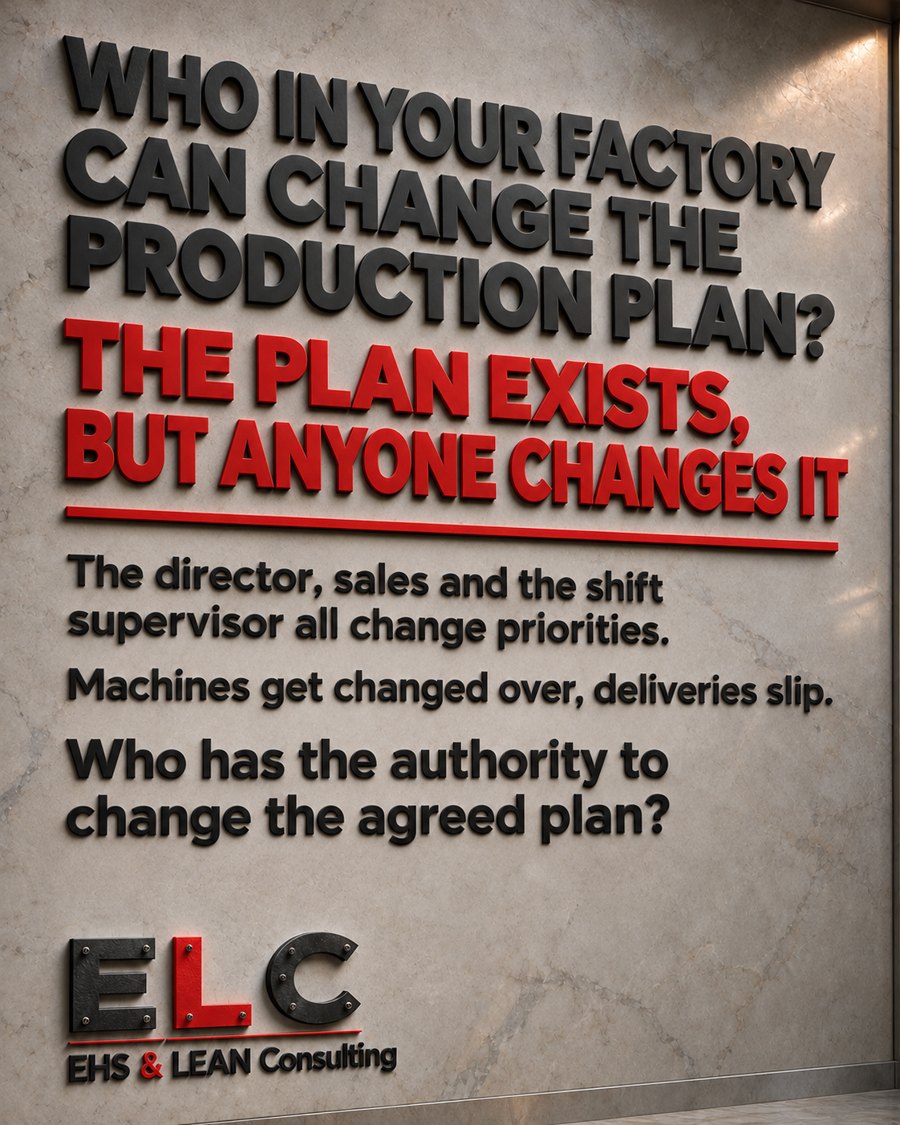
Who in your factory can change the production plan?
The production plan exists, but the director, sales and the shift supervisor all change it. The result is extra changeovers, lost capacity and late deliveries.
The biggest problems in production planning are often created by the very people responsible for making sure the plan is followed. In the factories I work with, a production plan exists, but in practice almost anyone can change it. The director changes priorities, sales issues orders directly to production, and plant and shift managers decide on their own what will be produced and in what sequence.
What a plan that anyone can change looks like
The plan is printed in the morning and pinned to the board. By ten o’clock the first work order has already been interrupted, because sales promised a customer an earlier date. The director walks through the hall and asks for his customer to go first. The shift supervisor sees that material is missing for the third order and puts the fourth in front of it. Each of those decisions has a reason, and each was made with good intentions. Together they produce a plant where nobody knows what will be run in the afternoon.
What the company pays for constant plan changes
Every change of priority means a machine changeover, tool adjustment and trial pieces before a good batch starts. That is time when the machine stands still and the operator is still paid. Capacity is lost and deliveries slip, even though the machines ran all day. Operators feel the pressure, because the job they started suddenly no longer matters, and what they had to stop is later requested as urgent. The planner in such a company mostly rearranges the schedule, and the time goes into the problems the changes created.
What Taylor wrote in 1903
In Shop Management, Frederick Winslow Taylor wrote that the shop, and indeed the entire factory, should be managed by a planning department and not by the director, superintendent or foreman. 123 years have passed, and I still see the same problem in many factories.
How I solve this problem
The first question I ask is who owns the plan. There has to be one name, not three. Then a rule is written down: who can request a change, who approves it, and until what point in the shift a change is still possible. An urgent order gets its place in the plan through the planner, and not behind the shift supervisor’s back.
The plan has to rest on realistic times. When standard times and line capacity are measured, the planner knows what fits into a shift and what does not, and can give the director and sales a realistic delivery date instead of a promise that will break later. For that I use measured standard times and bottleneck analysis.
At the start of the shift I check whether production started according to the plan. If it did not, the cause is written down the same day: material is missing, the tool is not ready, the machine is broken. That shows which deviations repeat, so they are fixed at the root and not over and over again. For changes during the day, a Plan B is agreed in advance together with logistics and with the plant. Logistics knows the supply priorities, and the plant knows what machines and people can actually deliver.
Try this week
Write down who changed the production plan in your factory over the last seven days, how many times and why. For each change, note how long the changeover took and which order was late because of it. The list is usually longer than you expect.
Who actually plans production in your factory, and who has the authority to change the agreed plan?
When the plan keeps changing, it is worth measuring where the plant really loses capacity. The Bottleneck Analysis shows where production stops and why delivery dates do not hold.